Oct 23-2025
Plastic Twist Ties: A Smart Assistant for Food Packaging
READ MORE >

Twist ties are commonly supplied in two formats: pre-cut pieces and continuous rolls. The choice between them isn't about which is "better" overall, but how each format affects your daily handling, cutting steps, and workflow rhythm. This guide compares the two to help you determine which format aligns with your actual closing process.
What Are Pre-Cut Twist Ties?
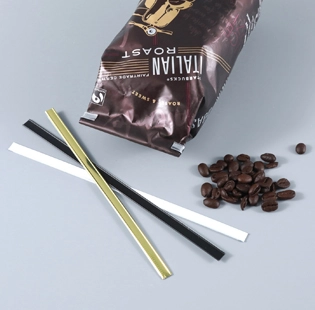
Pre-cut twist ties are individual, standalone pieces that have already been cut to a specific length before they reach your workstation.
They are supplied as ready-to-use items. The operator simply takes one tie, gathers the bag opening, positions the tie around the neck, and twists to secure. No measurement or cutting is required at the point of use—the tie is applied directly.
What Are Continuous Twist Tie Rolls?
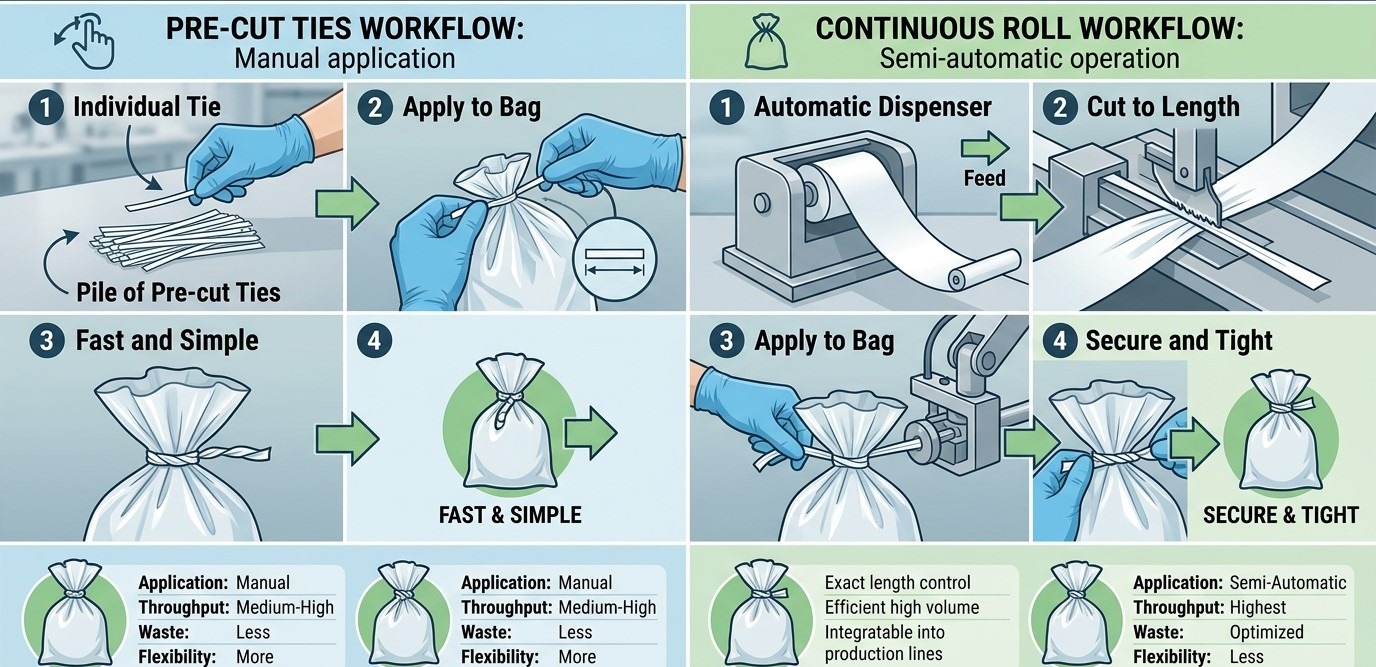
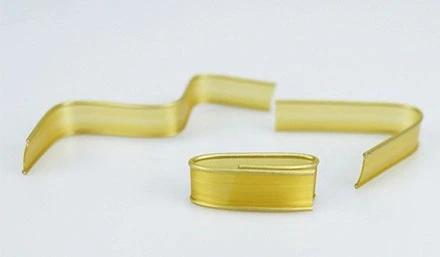
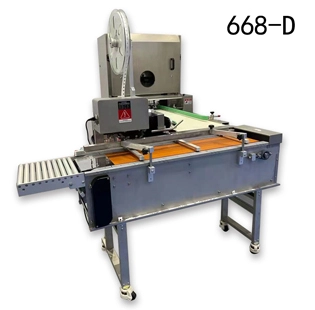
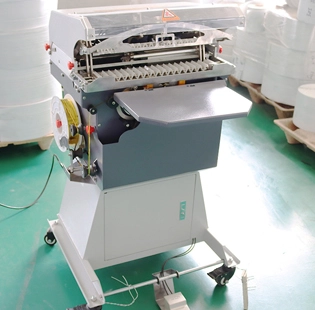
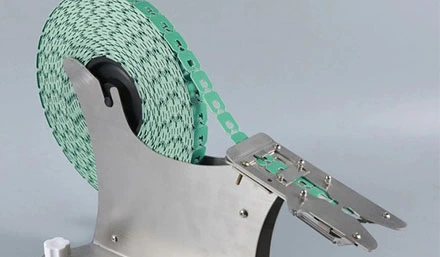
Continuous twist tie rolls supply the material as a continuous length of twist tie material wound onto a roll. Instead of receiving individual pieces, the operator or equipment dispenses a section from the roll and cuts it to the needed length during use.
A typical workflow involves feeding the material, dispensing the required length, cutting it from the roll, and then applying and twisting it onto the gathered bag. With this format, the individual tie is created as part of the closing operation itself.
Key Differences Between the Two Formats
The table below summarizes the core operational distinctions.
| Factor | Pre-Cut Twist Ties | Continuous Twist Tie Rolls |
|---|---|---|
| Supply format | Individual, separate pieces | Continuous material on a roll |
| Cutting before use | Not required—already cut | Required during dispensing |
| Handling | Pick up and apply one tie at a time | Feed and cut material before application |
| Length | Predetermined and fixed | Determined during dispensing (depending on setup) |
| Workflow integration | Simple, piece‑by‑piece application | Dispensing and cutting are part of the workflow |
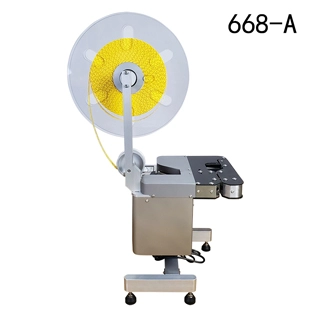
| Equipment compatibility | Suitable for manual or simple assisted processes | Can be used with suitable dispensing or cutting equipment |
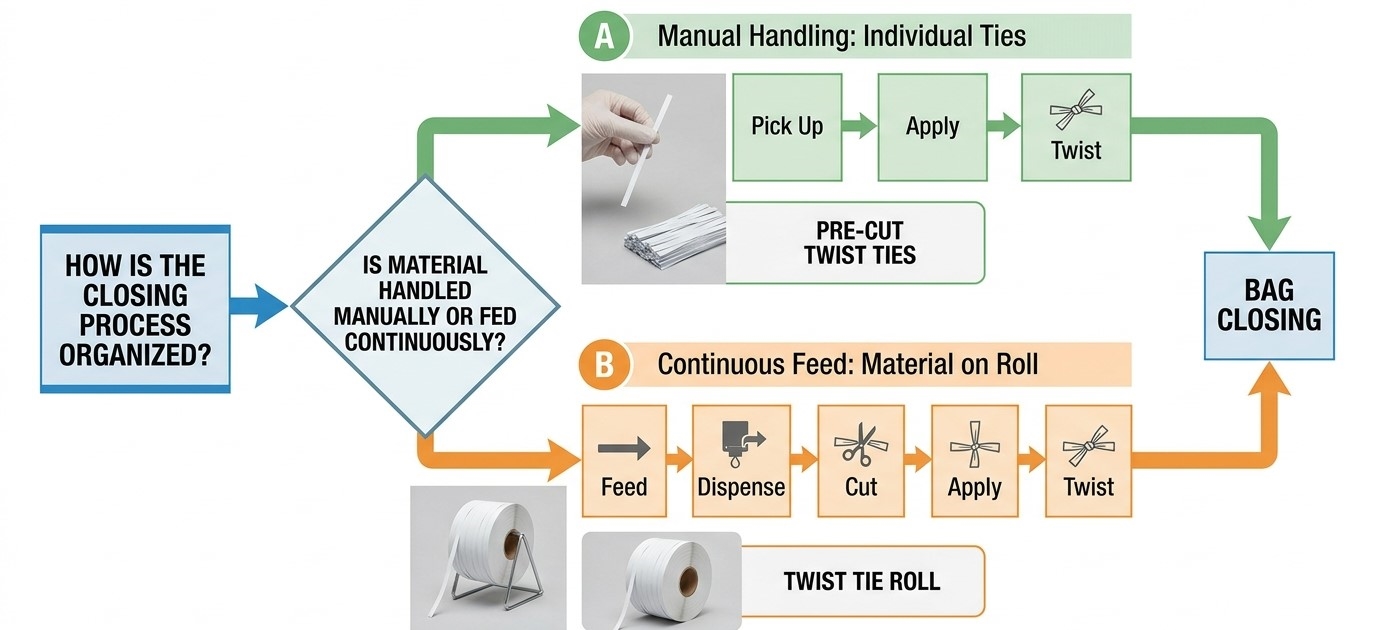
Which Twist Tie Format Fits Your Workflow?
This decision comes down to three practical factors, rather than a general "better or worse" comparison.
1. Individual-piece handling vs. continuous feeding
If your process is set up for operators to pick up and apply ready-made items, pre-cut ties are a logical choice. If your workflow is built around continuous material input, rolls are more appropriate.
2. Is cutting part of your process?
If you prefer to eliminate cutting from the live closing operation, pre-cut ties simplify the workflow. If your operation already involves or can accommodate a cutting step, roll formats are worth considering.
3. Manual vs. equipment-assisted process
For purely manual operations, pre-cut ties are straightforward and require no additional tools. For workflows that involve or plan to incorporate assisting equipment, twist tie rolls may be suitable when dispensing or cutting equipment is part of the process.
| If your workflow... | Consider... |
|---|---|
| Uses individual ties directly | Pre-cut twist ties |
| Does not require cutting during operation | Pre-cut twist ties |
| Uses continuous material feeding | Twist tie rolls |
| Includes dispensing and cutting steps | Twist tie rolls |
| Is being integrated with suitable equipment | Twist tie rolls may be worth evaluating |
The choice should be based on your actual closing workflow, handling method, and equipment setup—rather than the tie format alone.
What to Check Before Choosing
Before finalizing your decision, review these four practical questions:
How are the ties supplied—as individual pieces or as a continuous roll?
Is cutting required during the closing operation, or can it be done beforehand?
How does the operator physically handle and position the tie?
Is dispensing equipment already part of your process, or planned for the future?
Conclusion
Pre-cut ties are ready-to-use individual pieces, while continuous rolls require dispensing and cutting as part of the workflow. The right format depends on your handling method, cutting requirements, and equipment use—not on a universal advantage.
For a closer look at roll-format twist ties, the next article explains how continuous twist tie material is dispensed and cut during use.